

High energy and nutrient content are crucial in order to gain the maximum from the basic ration. Only by producing forage which is rich in energy and nutrients will you be able to reduce the quantity of concentrates that have to be used. To achieve this, some natural principles and basic characteristics of different forage species must first be taken into account.
Crop development and cutting time
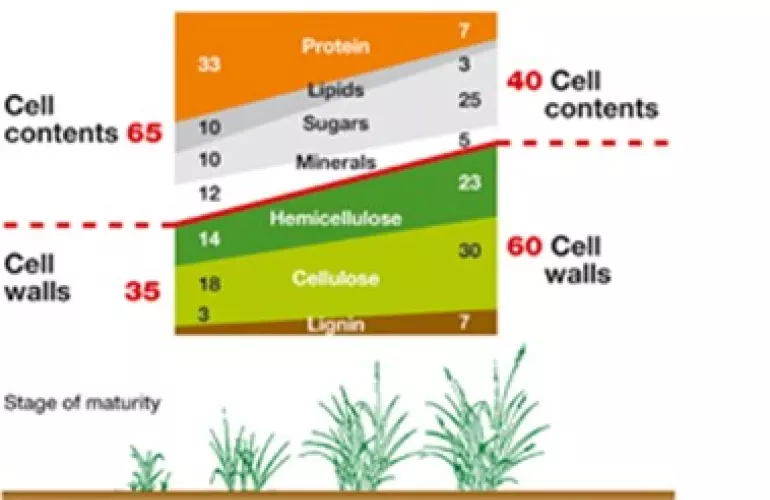
During their development, the composition of forage plants changes. With grass, for example, the stage of maturity has a big influence on the repartition of cell contents (protein, lipids, sugars and minerals) and cell walls (hemicellulose, cellulose and lignin), as the share of the latter increases steadily during growth.
As a result, the grass nutrient content, especially protein and minerals, declines whereas the crude fiber content rises. Moreover, an increasing percentage of crude fiber reduces the energy content as well as lowering the digestibility and feed intake by the animals.
Influence of crude fibre and energy content of grass covers of different ages on the milk performance
| Days of growth after optimal cutting time | ||||
|---|---|---|---|---|
| 0 | 4 | 8 | 12 | |
| Parameters of feed value | ||||
| Crude fibre content (g/kg DM) | 240 | 260 | 280 | 300 |
| Energy content (MJ NEL/kg DM) | 6.6 | 6.4 | 6.1 | 5.9 |
| Green fodder intake and feeding success | ||||
| Dry matter intake (relatively in %) | 100 | 92 | 82 | 80 |
| Energy intake (relatively in %) | 100 | 89 | 79 | 71 |
| Milk performance (relatively in %) | 100 | 80 | 64 | 50 |
Source: Jeroch et. al., 2008